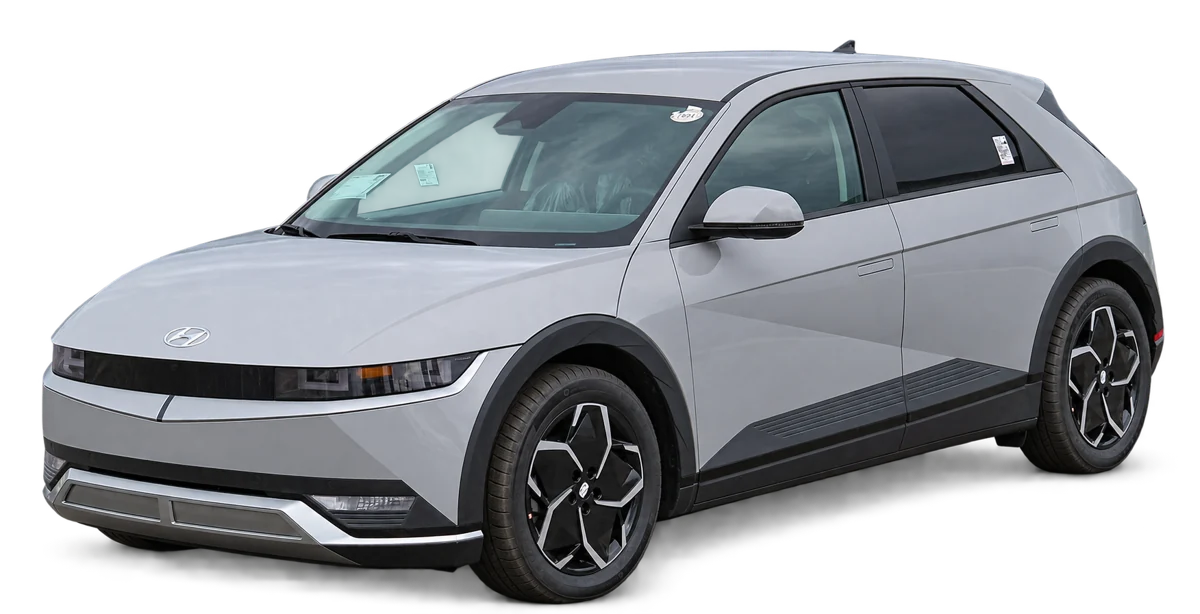
Open this section to check available listings. No listing request is made until you open it.
Source: Car Handshake and participating dealerships. Year, make and model must match to appear here; trims and specifications can differ. Listings do not establish vehicle condition or recall repair status.
Reported Problem Categories
US NHTSA complaints for the 2022 Hyundai Ioniq 5.
ELECTRICAL SYSTEM
307
FUEL/PROPULSION SYSTEM
90
POWER TRAIN
85
ENGINE
36
UNKNOWN OR OTHER
30
NHTSA documents known discrepancies in its bulk complaint file. Consumer allegations are not confirmed defects. One complaint can mention several categories. Counts are not failure rates.
At a Glance
Source configurations, without assumed specifications.
US campaigns received since 2010; not a complete lifetime recall history, including historical or superseded records.
ELECTRICAL SYSTEM:12V/24V/48V BATTERY
Hyundai Motor America (Hyundai) is recalling certain 2022-2024 IONIQ 5, 2023-2025 IONIQ 6, Genesis GV60, Genesis GV70 "Electrified," and Genesis G80 "Electrified" vehicles. The Integrated Charging Control Unit (ICCU) may become damaged and stop charging the 1…
Read the complete source summary
Hyundai Motor America (Hyundai) is recalling certain 2022-2024 IONIQ 5, 2023-2025 IONIQ 6, Genesis GV60, Genesis GV70 "Electrified," and Genesis G80 "Electrified" vehicles. The Integrated Charging Control Unit (ICCU) may become damaged and stop charging the 12-volt battery, which can result in a loss of drive power.
Consequence: A loss of drive power increases the risk of a crash.
Remedy: Dealers will inspect and replace the ICCU and its fuse, as necessary. In addition, dealers will update the ICCU software. All repairs will be performed free of charge. Owner notification letters were mailed December 20, 2024. Owners may contact Hyundai customer service at 1-855-371-9460 or Genesis customer service at 1-844-340-9741. Hyundai's numbers for this recall are 272 (Hyundai) and 025G (Genesis). This recall expands and replaces previous recall number 24V-204. Vehicles previously repaired under recall 24V-204 will need to have the new remedy completed.
Hyundai Motor America (Hyundai) is recalling certain 2022-2024 IONIQ 5, 2023-2024 IONIQ 6, Genesis GV60, Genesis GV70 "Electrified," and Genesis G80 "Electrified" vehicles. The Integrated Charging Control Unit (ICCU) may become damaged and stop charging the 1…
Read the complete source summary
Hyundai Motor America (Hyundai) is recalling certain 2022-2024 IONIQ 5, 2023-2024 IONIQ 6, Genesis GV60, Genesis GV70 "Electrified," and Genesis G80 "Electrified" vehicles. The Integrated Charging Control Unit (ICCU) may become damaged and stop charging the 12-Volt battery, which can result in a loss of drive power.
Consequence: A loss of drive power increases the risk of a crash.
Remedy: This recall is replaced by NHTSA recall number 24V-868. Vehicles already repaired under this recall will need to have the new remedy completed. Dealers will inspect and replace the ICCU and its fuse, as necessary. In addition, dealers will update the ICCU software. All repairs will be performed free of charge. Owner notification letters were mailed April 22, 2024. Owners may contact Hyundai customer service at 1-855-371-9460. Hyundai's number for this recall is 257/021G.
PARKING BRAKE:ELECTRICAL:CONTROL MODULE:SOFTWARE
Hyundai Motor America (Hyundai) is recalling certain 2022 Ioniq 5 vehicles. A software error in the Shifter Control Unit (SCU) may disengage the parking mechanism, which can allow the vehicle to rollaway.
Consequence: Vehicle rollaway can increase the risk of a crash or injury.
Remedy: Drivers are recommended to use the Electronic Parking Brake (EPB) when parking their vehicles until the remedy has been performed. Dealers will update the Shifter Control Unit software, free of charge. Owner notification letters were mailed July 14, 2022. Owners may contact Hyundai customer service at 1-855-371-9460. Hyundai's number for this recall is 228.
Reports Over Time
US complaints by filing month, latest 12 observed months.
25-11
25-12
26-01
26-02
26-03
26-04
26-05
26-06
26-07
26-08
26-09
26-10
A month with no bar is not evidence that no problems occurred. Publication and reporting delays affect totals.
Read chart data
2025-11
9
2025-12
8
2026-01
29
2026-02
23
2026-03
13
2026-04
10
2026-05
3
2026-06
2
2026-07
3
2026-08
2
2026-09
4
2026-10
1
RECHECK EVIDENCE LAB
The mileage lens
Where the available US complaint records fall by reported mileage.
Reported mileage at incident
Matched complaint records
Below 25,000 mi
11
25,000–49,999 mi
5
50,000–99,999 mi
2
100,000–149,999 mi
2
150,000+ mi
0
Missing or excluded mileage
387
20 of 407 matched complaints have positive, usable mileage. Source zero values can represent missing information and are excluded; values above 1.5 million miles are excluded. These are selected allegations with no vehicle-population denominator. The table cannot predict when your vehicle will fail. Mileage is retained in US source miles.
Crash flagged7US complaint allegations
Fire flagged1US complaint allegations
Towed flagged11US complaint allegations
Positive source flags are counted per deduplicated complaint, not verified incidents. Categories and flags can overlap; an unflagged or missing value does not prove an incident did not occur.
RECHECK EVIDENCE LAB
Your annual energy budget
Use official test estimates with your own distance and prices.
Scenario estimate, not a live price quote or total cost of ownership. Uses the selected source configuration’s combined test consumption. Weather, speed, battery condition, charging losses, taxes, maintenance, depreciation and insurance can change actual cost. Plug-in hybrids are excluded from this simple calculator because fuel and electricity use depend on charging behaviour. Your inputs stay in your browser.
407 deduplicated US complaint records. The most frequently named component categories are:
electrical system · 307 records
fuel/propulsion system · 90 records
power train · 85 records
“Unknown or other” records are included in the total; they do not identify a component. Categories overlap. These are allegations, not confirmed defects or a failure rate.
Coverage boundary: US campaigns received since 2010; not a complete lifetime recall history Exact normalized make/model/year safety matches. Efficiency retains explicitly named source configurations; spelling/configuration differences may exclude records. US complaint counts do not establish Canadian experience or the probability of a defect.
Accident history, current mechanical condition, ownership, liens, individual recall applicability, repair completion and battery health are not established by this model-year report. No failure rate or reliability score is calculated from raw complaint totals.
Specifications & Efficiency
Official source configurations. No trim is assumed.
Source configuration
Fuel / powertrain
Combined efficiency
Range
Ioniq 5 AWD (Long Range) Automatic (A1)
Electricity All-Wheel Drive
34.3285 kWh/100 mi
256 mi
Ioniq 5 RWD (Long Range) Automatic (A1)
Electricity Rear-Wheel Drive
30.0 kWh/100 mi
303 mi
Ioniq 5 RWD (Standard Range) Automatic (A1)
Electricity Rear-Wheel Drive
31.0 kWh/100 mi
220 mi
Official test estimates vary with configuration, driving and weather. Fuel codes are retained as published; US and Canadian test measures are shown in their source units. Plug-in hybrid source ranges and operating modes are shown separately; they are not added together.
More from the official configuration records
Figures belong to each source configuration. Test conditions and charging assumptions apply; tailpipe emissions exclude fuel and electricity production. No missing specifications are inferred.
US official records; applicability in Canada is not established.
52 matched manufacturer communications · 3 matched investigations. Communications are not necessarily recalls or technical service bulletins.
DP22005 · Pedestrian alert sounds
NHTSA received a petition on or about July 18, 2022, requesting that Federal Motor Vehicle Safety Standard (FMVSS) 141 be applied to all electric and hybrid vehicles operating in the United States. The petition can be reviewed at NHTSA.gov under ODI Number 11486072. FMVSS 141 establishes performance requirements for pedestrian alert sounds for motor vehicles. The standard applies to hybrid and electric vehicles that have a gross vehicle weight rating of 4,536 KG or less or are defined as low-speed vehicles. The standard became fully applicable to all such vehicles manufactured on or after March 1, 2021.On January 27, 2023, NHTSA opened Defect Petition (DP) 22-005 to evaluate the subject matter described in the petition. On June 24, 2023 and as supplemented on June 25, 2023, the petitioner notified NHTSA he was withdrawing his petition. The petitioner indicated that, based on his review of data, there is no justification for asserting potential benefits that could be derived from actions sought by my petition. Based on the petitioner's withdrawal, DP22-005 is closed. Closure of this DP does not represent a determination by NHTSA regarding the subject matter of the petition.
On June 8, 2023, the Office of Defect Investigation (ODI) opened PE23011 to investigate allegations of loss of motor power on model year (MY) 2022 Hyundai Ioniq 5 vehicles. Some consumers reported loss of motor power immediately after a warning lamp illumination or reduction of motive power while the vehicle was in motion. This investigation found that the Integrated Charging Control Unit (ICCU) may be subject to various conditions such as overcurrent, overvoltage induced at the end of charging, and certain thermal loading during operation that can damage its internal components and open the ICCU fuse, resulting in an inability to charge the 12-volt battery. The vehicle could eventually lose all motive power, increasing the risk of a crash. In July 2023, Hyundai issued a service campaign to address certain MY 2022-2023 Ioniq 5 and MY 2023 Ioniq 6 vehicles that may have low 12V auxiliary battery charging occurrences due to an ICCU fault and may set the DTC P1A9096 “DC/DC Converter Input Voltage Sensor Fault”. On March 15, 2024, Hyundai filed Safety Recall 24V-204 for 98,878 MY 2022-2024 Hyundai Ioniq 5 vehicles and MY 2023-2024 Hyundai Ioniq 6, Genesis GV60, Genesis GV70 “Electrified” and Genesis G80 “Electrified” vehicles. The recall remedy provides an inspection, and if necessary, a replacement of the ICCU and the associated fuse. The ICCU software reduces the risk of overcurrent and implements voltage peak reduction at the end of EV battery charging. The recall also includes a software update that revises the electric water pump operational threshold to reduce thermal loading during charging and driving. In view of the recall action being taken by Hyundai, ODI is closing this Preliminary Evaluation. The agency reserves the right to take additional action if warranted by future circumstances. To review the reports cited in the Closing Resume ODI Report Identification Number document, go to NHTSA.gov.
Opened 20230608 · Closed 20240417
Official investigation archive ↗PE24028 · Electrical arcing and thermal events, potentially leading to fires, while utilizing Enel X Way USA, LLC's JuiceBox residential charger.
On October 3, 2024, the Office of Defects Investigations (ODI) opened PE24028 to investigate alleged failures of Enel X Way's JuiceBox Level 2 residential EV chargers. The allegations were described as thermal incidents and electrical malfunctions, which could trip the circuit breakers in Juicebox owners’ homes and disrupt electric vehicle charge cycles. On October 2, 2024, Enel X Way posted on its website that Enel X Way North America would cease operations in the United States and Canada on October 11, 2024. The closure would potentially impact the charging app and supporting software. ODI sent Enel X Way an Information Request (IR) letter on October 21, 2024. Enel X Way provided an incomplete response to the IR on December 9, 2024. Enel X Way later provided a complete response to the IR on January 24, 2025. ODI reviewed Enel X Way’s IR submissions to determine whether further action is required. Based on ODI’s analysis, there was no clear trend in the cause of the failures described in customer complaints and warranty reports. Additionally, there have been no recent reports alleging safety issues. The available information does not warrant further action at this time. The closing of this investigation does not constitute a finding by NHTSA that a safety-related defect does not exist. The Agency will continue to monitor for any safety trends and reserves the right to take additional action if warranted by future circumstances. To review the ODI reports cited in this Closing Resume, go to NHTSA.gov.
Showing up to 8 communication summaries and 4 investigations. Export coverage: communications received 2020–2026 only. Canadian applicability is not inferred. Consult NHTSA for full records.
Before You Buy
Questions to take to a seller or qualified mechanic.
Verify the VIN and ask the manufacturer to confirm applicability and completion of recall repairs.
Ask for documentation related to the official ELECTRICAL SYSTEM:12V/24V/48V BATTERY campaign (24V868000).
Ask for documentation related to the official ELECTRICAL SYSTEM:PROPULSION SYSTEM:CHARGING:MODULE:SOFTWARE campaign (24V204000).
Ask a mechanic to investigate any symptoms associated with reported categories; complaints alone are not a diagnosis.
Review service records and arrange an independent pre-purchase inspection.
A research brief for the 2022 Hyundai Ioniq 5, built from this report.
Record the VIN, market and exact powertrain. Confirm open recalls and completed remedies with the manufacturer.
Ask for repair documentation for campaign 24V868000 (ELECTRICAL SYSTEM:12V/24V/48V BATTERY). A model-year match does not establish that this VIN is affected.
Ask for repair documentation for campaign 24V204000 (ELECTRICAL SYSTEM:PROPULSION SYSTEM:CHARGING:MODULE:SOFTWARE). A model-year match does not establish that this VIN is affected.
Ask for repair documentation for campaign 22V324000 (PARKING BRAKE:ELECTRICAL:CONTROL MODULE:SOFTWARE). A model-year match does not establish that this VIN is affected.
electrical system: 307 matched US complaint records mention this category. Ask the seller about related symptoms, prior diagnosis and documented repairs; ask an independent mechanic which checks fit this exact configuration.
fuel/propulsion system: 90 matched US complaint records mention this category. Ask the seller about related symptoms, prior diagnosis and documented repairs; ask an independent mechanic which checks fit this exact configuration.
power train: 85 matched US complaint records mention this category. Ask the seller about related symptoms, prior diagnosis and documented repairs; ask an independent mechanic which checks fit this exact configuration.
Compare service records with the manufacturer’s schedule and arrange an independent pre-purchase inspection. This checklist is not a diagnosis or an expert inspection.