Open this section to check available listings. No listing request is made until you open it.
Source: Car Handshake and participating dealerships. Year, make and model must match to appear here; trims and specifications can differ. Listings do not establish vehicle condition or recall repair status.
Canadian owner complaints
Coverage, without substituted US totals.
Canadian complaint totals are not available in Recheck’s current dataset. This does not mean there are no complaints.
Canadian recalls come from Transport Canada and efficiency ratings from NRCan. US complaints and bulletins are optional context below; they do not establish Canadian applicability.
Canadian archive snapshot, including historical or superseded records.
Seats And Restraints
Issue:
On certain vehicles, the weight sensor for the front passenger seat may not have been manufactured properly. As a result, the passenger-front airbag and knee airbag could deploy in a crash that doesn't require them to.
Note: This recall is an expansio…
Read the complete source summary
Issue:
On certain vehicles, the weight sensor for the front passenger seat may not have been manufactured properly. As a result, the passenger-front airbag and knee airbag could deploy in a crash that doesn't require them to.
Note: This recall is an expansion of Transport Canada recall no. 2024-059. If the weight sensor fails, the SRS warning light would turn on in the instrument panel.
Safety Risk:
An airbag system that doesn't work properly could increase the risk of injury in a crash.
Corrective Actions:
The company will notify owners by mail and advise you to take your vehicle to a dealership to replace the passenger-front seat weight sensor.
Issue:
On certain vehicles, the weight sensor for the front passenger seat may not have been manufactured properly. As a result, the passenger-front airbag and knee airbag could deploy in a crash that doesn't require them to.
Note: If the weight sensor fails…
Read the complete source summary
Issue:
On certain vehicles, the weight sensor for the front passenger seat may not have been manufactured properly. As a result, the passenger-front airbag and knee airbag could deploy in a crash that doesn't require them to.
Note: If the weight sensor fails, the SRS warning light would turn on in the instrument panel.
Safety Risk:
An airbag system that doesn't work properly could increase the risk of injury in a crash.
Corrective Actions:
Honda will notify owners by mail and advise you to take your vehicle to a dealership for an inspection if the SRS warning light is on. If the SRS warning light is on due to a faulty weight sensor, the weight sensor will be replaced. When repair parts are available, Honda will send you a second letter. They will advise you to take your vehicle to a dealership to replace the passenger-front seat weight sensor.
Model-year recalls do not establish repair completion.
Confirm open recalls with the manufacturer and ask a dealer whether the repairs are complete. Recheck’s VIN decoder identifies the vehicle; it does not provide recall repair status.
Use official test estimates with your own distance and prices.
Scenario estimate, not a live price quote or total cost of ownership. Uses the selected source configuration’s combined test consumption. Weather, speed, battery condition, charging losses, taxes, maintenance, depreciation and insurance can change actual cost. Plug-in hybrids are excluded from this simple calculator because fuel and electricity use depend on charging behaviour. Your inputs stay in your browser.
Coverage boundary: Canadian archive snapshot Exact normalized make/model/year safety matches. Efficiency retains explicitly named source configurations; spelling/configuration differences may exclude records. US complaint counts do not establish Canadian experience or the probability of a defect.
Accident history, current mechanical condition, ownership, liens, individual recall applicability, repair completion and battery health are not established by this model-year report. No failure rate or reliability score is calculated from raw complaint totals.
Specifications & Efficiency
Official source configurations. No trim is assumed.
Source configuration
Fuel / powertrain
Combined efficiency
Range
CR-V AV
X 1.5 L engine
7.7 L/100 km
Data unavailable
CR-V AWD AV
X 1.5 L engine
8.1 L/100 km
Data unavailable
Official test estimates vary with configuration, driving and weather. Fuel codes are retained as published; US and Canadian test measures are shown in their source units. Plug-in hybrid source ranges and operating modes are shown separately; they are not added together.
More from the official configuration records
Figures belong to each source configuration. Test conditions and charging assumptions apply; tailpipe emissions exclude fuel and electricity production. No missing specifications are inferred.
CR-V · AV — source specification details
Vehicle class
Sport utility vehicle: Small
Engine displacement
1.5 L
Cylinders
4
City fuel consumption
8.3 L/100 km
Highway fuel consumption
7.0 L/100 km
Tailpipe CO₂ emissions
180 g/km
CR-V AWD · AV — source specification details
Vehicle class
Sport utility vehicle: Small
Engine displacement
1.5 L
Cylinders
4
City fuel consumption
8.7 L/100 km
Highway fuel consumption
7.4 L/100 km
Tailpipe CO₂ emissions
189 g/km
Canadian defect investigations
Check the current official Transport Canada register.
Canadian investigation records are not imported into this report. Check the official register for affected vehicles, investigation details and current status; no match or status is implied here.
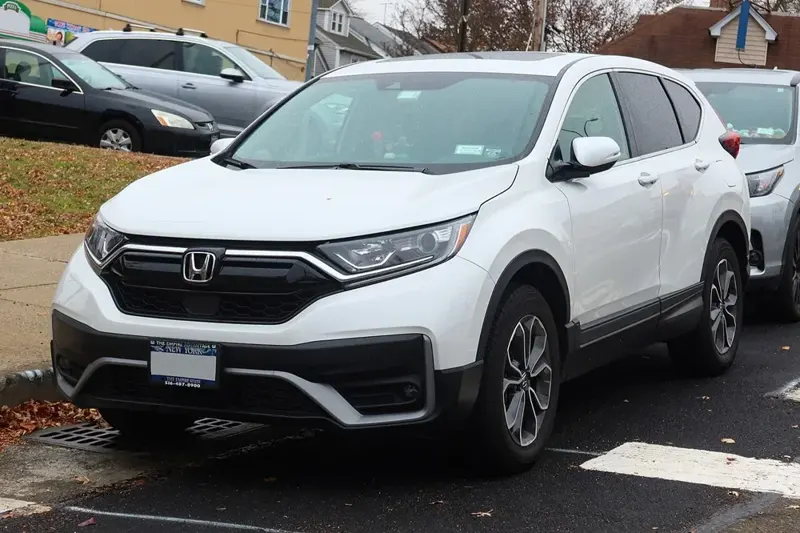
A research brief for the 2021 Honda Cr-V, built from this report.
Record the VIN, market and exact powertrain. Confirm open recalls and completed remedies with the manufacturer.
Ask for repair documentation for campaign 2026251 (Seats And Restraints). A model-year match does not establish that this VIN is affected.
Ask for repair documentation for campaign 2024059 (Airbag). A model-year match does not establish that this VIN is affected.
Compare service records with the manufacturer’s schedule and arrange an independent pre-purchase inspection. This checklist is not a diagnosis or an expert inspection.
Optional US contextNHTSA complaints, communications and investigations · not Canadian records
These are US records. Models, equipment, campaigns and driving conditions can differ. Counts are not Canadian complaint totals, verified reviews or reliability ratings.
Reported Problem Categories
US NHTSA complaints for the 2021 Honda Cr-V.
STEERING
117
FORWARD COLLISION AVOIDANCE
89
UNKNOWN OR OTHER
38
ELECTRICAL SYSTEM
35
ENGINE
35
US context, not Canadian complaint counts. NHTSA documents known discrepancies in its bulk complaint file. Consumer allegations are not confirmed defects. One complaint can mention several categories. Counts are not failure rates.
Reports Over Time
US complaints by filing month, latest 12 observed months.
25-12
26-01
26-02
26-03
26-04
26-05
26-06
26-07
26-08
26-09
26-10
26-11
A month with no bar is not evidence that no problems occurred. Publication and reporting delays affect totals.
Read chart data
2025-12
9
2026-01
2
2026-02
8
2026-03
12
2026-04
17
2026-05
11
2026-06
17
2026-07
8
2026-08
9
2026-09
9
2026-10
8
2026-11
6
RECHECK EVIDENCE LAB
The mileage lens
Where the available US complaint records fall by reported mileage.
Reported mileage at incident
Matched complaint records
Below 25,000 mi
24
25,000–49,999 mi
17
50,000–99,999 mi
11
100,000–149,999 mi
2
150,000+ mi
0
Missing or excluded mileage
291
54 of 345 matched complaints have positive, usable mileage. Source zero values can represent missing information and are excluded; values above 1.5 million miles are excluded. These are selected allegations with no vehicle-population denominator. The table cannot predict when your vehicle will fail. Mileage is retained in US source miles.
Crash flagged14US complaint allegations
Fire flagged1US complaint allegations
Towed flagged15US complaint allegations
Positive source flags are counted per deduplicated complaint, not verified incidents. Categories and flags can overlap; an unflagged or missing value does not prove an incident did not occur.
Bulletins & Investigations
US official records; applicability in Canada is not established.
127 matched manufacturer communications · 2 matched investigations. Communications are not necessarily recalls or technical service bulletins.
EA24002 · Inadvertent Automatic Emergency Braking
On February 21, 2022, the Office of Defects Investigation (ODI) opened Preliminary Evaluation (PE22003) to assess reports of inadvertent activation of the Collision Mitigation Braking System (CMBS), an automatic emergency braking (AEB) system, in model year 2017-2019 Honda CR-V and 2018-2019 Honda Accord vehicles. The reports allege that activation of the AEB system occurs while driving with no apparent obstruction in the vehicle's forward path, resulting in sudden vehicle deceleration. Honda indicated that they were aware of a total of X,XXX reports that may relate to the alleged defect. Honda provided analysis of the alleged defect and alleges that some customers possibly had an inadequate understanding of the CMBS and its limitations. However, many consumer complaints allege that Honda dealerships were unable to reproduce the condition or state that they were informed that this is considered normal CMBS operation. To date, ODI has received a total of 1,294 consumer complaints of inadvertent activation of CMBS in 2017-2022 Honda CR-V and 2018-2022 Honda Accord vehicles. A total of 31 complaints alleged a crash and 50 alleged an injury. The Total column in the Failure Report Summary removes duplicate reports and shows the total number of reports with unique VINs from all Manufacturer, ODI, and EWR data sources. In some cases, there were multiple reports associated with a particular vehicle in which recurring failures were alleged. In total, there were X,XXX reports, 93 injury incidents and 47 crashes involving vehicles with unique VINs that may relate to the alleged defect. PE22-003 has been upgraded to an Engineering Analysis to further assess the scope, frequency, and potential safety related consequences of the inadvertent AEB activations. The scope has been expanded to include assessment of model year 2020-2022 Honda CR-V and Accord vehicles. To review the ODI reports cited in the Opening Resume ODI Report Identification Number document, go to NHTSA.gov.
On November 29, 2022, the Office of Defects Investigation (ODI) opened PE 22-011 after reviewing field reports alleging rear differential seizure in 2018-2022MY Honda CR-V and HR-V vehicles equipped with all wheel drive. To date, ODI has not received any consumer complaints. Some of the field reports received alleged the vehicle’s wheels locked up with no warning while the vehicle was in motion. These vehicles were towed to a dealership. Examination of these vehicles showed the driveshaft had broken and the differential unit was completely damaged. The field reports cited a lack of oil due to damaged oil seals as the cause. Honda provided data including consumer complaints, field reports, and warranty claims they received relating to the loss of oil retention and resulting differential damage. Honda’s data cited 1201 incidents with unique vehicle identification numbers (VINs). The rear differential oil seals prevent the oil from leaking out and protect internal components from contaminants. A loss of oil lubrication results in failure of the vehicle differential. Honda stated that the oil seal’s lip contact with the driveshaft may become unstable due to intermittent changes in internal pressure. Their review of field report and warranty data indicated that these failures occurred early in the vehicle’s life thus the failures were covered by the manufacturer’s warranty. Honda stated that in November 2021 they changed the seal specifications and improved the packaging process of the parts for transport. Honda also enacted an enhanced visual inspection process both before and after the oil seal installation on the assembly line. Honda stated that in the event of differential failure, the operator can control the vehicle without stability loss. After the drive shafts break due to differential failure, the operator will hear noises and the vehicle will still function as a 2WD vehicle preventing complete loss of motive power. Based on the following factors, ODI is closing this investigation: · Information regarding field failures does not indicate hazardous outcomes · The failures are occurring early in the life of the vehicle · Repairs are covered under the manufacturer’s warranty · The vehicle can continue functioning as a 2WD without loss of stability control in the event of failure The closing of this investigation does not constitute a finding by NHTSA that a safety-related defect does not exist, and the agency reserves the right to take additional action if warranted by new circumstances.
Showing up to 8 communication summaries and 4 investigations. Export coverage: communications received 2020–2026 only. Canadian applicability is not inferred. Consult NHTSA for full records.
Sources & Last Updated
Trace the evidence behind this report.
Transport Canada Vehicle Recalls Database · Original source · Evidence updated Nov 17, 2026
US NHTSA complaints · optional US context only · Original source · Retrieved Nov 17, 2026 · Counts deduplicated by ODI number.